
Atom at a Glance
| Specification | RFC 4287, The Atom Syndication Format (December 2005) |
|---|---|
| Publishing protocol | RFC 5023, the Atom Publishing Protocol (AtomPub, 2007) |
| Namespace | http://www.w3.org/2005/Atom |
| MIME type | application/atom+xml |
| Date format | RFC 3339, e.g. 2026-11-11T09:00:00Z |
| Root element | <feed>, with <entry> elements |
A Minimal Atom Feed
<?xml version="1.0" encoding="UTF-8"?>
<feed xmlns="http://www.w3.org/2005/Atom">
  <id>tag:example.com,2026:feed</id>
  <title>Example Blog</title>
  <updated>2026-11-11T09:00:00Z</updated>
  <link rel="self" href="https://example.com/atom.xml" />
  <link rel="alternate" type="text/html" href="https://example.com/" />
  <author>
    <name>Jane Doe</name>
  </author>

  <entry>
    <id>tag:example.com,2026:post-1</id>
    <title>Why feeds still matter</title>
    <link rel="alternate" href="https://example.com/why-feeds-matter" />
    <updated>2026-11-11T09:00:00Z</updated>
    <summary>A short summary of the article.</summary>
  </entry>
</feed>
Feed Elements
| Element | Description | |
|---|---|---|
id | required | A permanent, universally unique IRI for the feed. Never change it. |
title | required | Human-readable title. A text construct. |
updated | required | The last time the feed changed in a significant way. |
author | conditional | Required unless every entry has its own author. A person construct. |
link | recommended | rel="self" for the feed URL (should be present) and rel="alternate" for the website. |
subtitle | optional | A description of the feed. A text construct. |
category | optional | Category with term (required), scheme and label attributes. |
contributor | optional | A person who contributed. A person construct; may repeat. |
generator | optional | The software that made the feed, with optional uri and version. |
icon | optional | URL of a small square image (1:1), like a favicon. |
logo | optional | URL of a larger image, ideally twice as wide as it is tall (2:1). |
rights | optional | Copyright and licensing information. A text construct. |
Entry Elements
| Element | Description | |
|---|---|---|
id | required | A permanent, unique IRI for the entry. |
title | required | Title of the entry. A text construct. |
updated | required | The last significant change to the entry. |
author | conditional | Required unless the feed (or the entry's source) has an author. |
content | conditional | The full content. Required if there is no link rel="alternate". |
link | recommended | rel="alternate" points to the web page of the entry. |
summary | conditional | A short summary. Required when content has a src attribute or is base64-encoded media. |
published | optional | The first publication date. Unlike updated, it never changes. |
category, contributor, rights | optional | As for the feed. |
source | optional | Metadata of the original feed when an entry is copied into another feed. |
Text Constructs: text, html and xhtml
Atom states explicitly how text is encoded, which ends the RSS guesswork. title, subtitle, summary, rights and content take a type attribute:
<title type="text">Fish & Chips</title>
<summary type="html"><p>Escaped <em>HTML</em></p></summary>
<content type="xhtml">
<div xmlns="http://www.w3.org/1999/xhtml">
<p>Inline <em>XHTML</em>, wrapped in exactly one div.</p>
</div>
</content>Without a type attribute, the value is text: tags are shown literally. content can also have a MIME type such as image/png, or point to external content with src.
Person Constructs
<author>
  <name>Jane Doe</name>
  <uri>https://example.com/about</uri>
  <email>jane@example.com</email>
</author>
name is required; uri and email are optional. contributor has the same structure.
Link Relations
| rel | Meaning |
|---|---|
alternate | An alternate version, usually the HTML page. The default when rel is missing. |
self | The URL of this feed document. |
related | A related resource, such as the page an entry comments on. |
enclosure | A media file, like a podcast episode. Add length and type. |
via | The source of the information. |
hub | A WebSub hub for push updates. |
replies | The comments feed for an entry (Atom Threading, RFC 4685). |
next, previous, first, last | Pages of a paged or archived feed (RFC 5005). |
A link always has an href, and may have type, hreflang, title and length. Only one alternate link is allowed per combination of type and hreflang.
Choosing IDs
Atom IDs must be absolute IRIs that never change. Three good options:
- The permalink, e.g.
https://example.com/posts/hello– simple, but don't change it when URLs change. - A tag URI (RFC 4151):
tag:example.com,2026:post-1842. The domain and date make it unique; it survives redesigns. - A UUID URN:
urn:uuid:1225c695-cfb8-4ebb-aaaa-80da344efa6a.
Dates in Atom
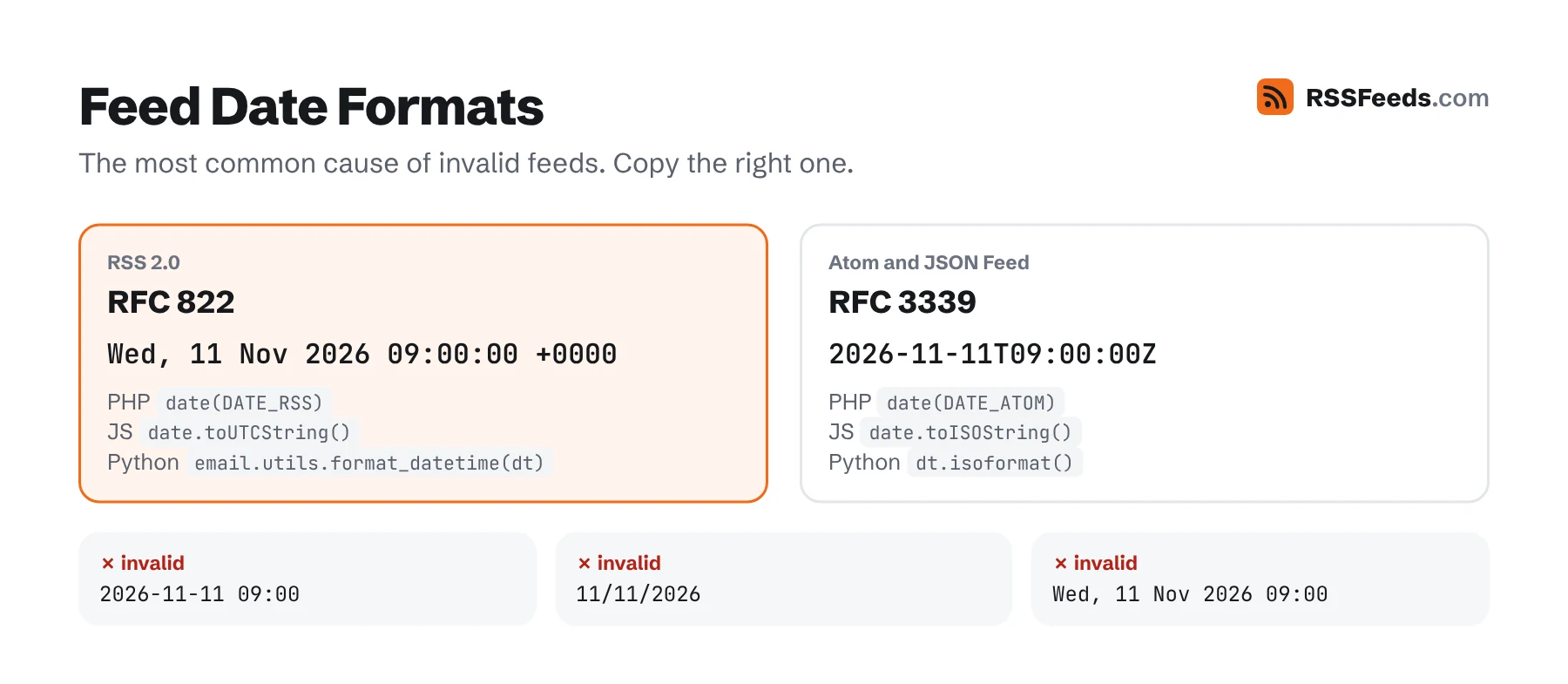
Atom uses RFC 3339, a profile of ISO 8601. The time and a time zone are mandatory:
2026-11-11T09:00:00Z
2026-11-11T10:00:00+01:00
2026-11-11T09:00:00.250Z
In PHP use date(DATE_ATOM), in JavaScript new Date().toISOString(), in Python dt.isoformat() on a time-zone-aware datetime.
Atom Elements Inside RSS
RSS feeds borrow one Atom element almost universally: <atom:link rel="self">, recommended by the RSS Advisory Board so that every RSS feed states its own URL. Declare the namespace as xmlns:atom="http://www.w3.org/2005/Atom". WebSub hubs are added the same way with rel="hub".
When to Choose Atom
Atom is the better choice when you need precise semantics: unambiguous content types, mandatory IDs and update dates, proper internationalisation with xml:lang and xml:base, and a standardised publishing protocol. Every modern reader supports it. For podcasts, use RSS 2.0: Apple Podcasts and most podcast apps require it. A full comparison is in RSS vs Atom vs JSON Feed.