The Short Answer
- Podcast? RSS 2.0. Apple Podcasts and most directories require it.
- Blog, news site or shop? RSS 2.0 is the safe default. Atom is equally good if your software produces it.
- Developer audience, or you build the feed by hand in code? JSON Feed is pleasant, ideally next to RSS.
- Need strict semantics, multiple languages or a publishing API? Atom.
Publishing two formats is fine; announce both with autodiscovery and readers pick one.
Side-by-Side Comparison
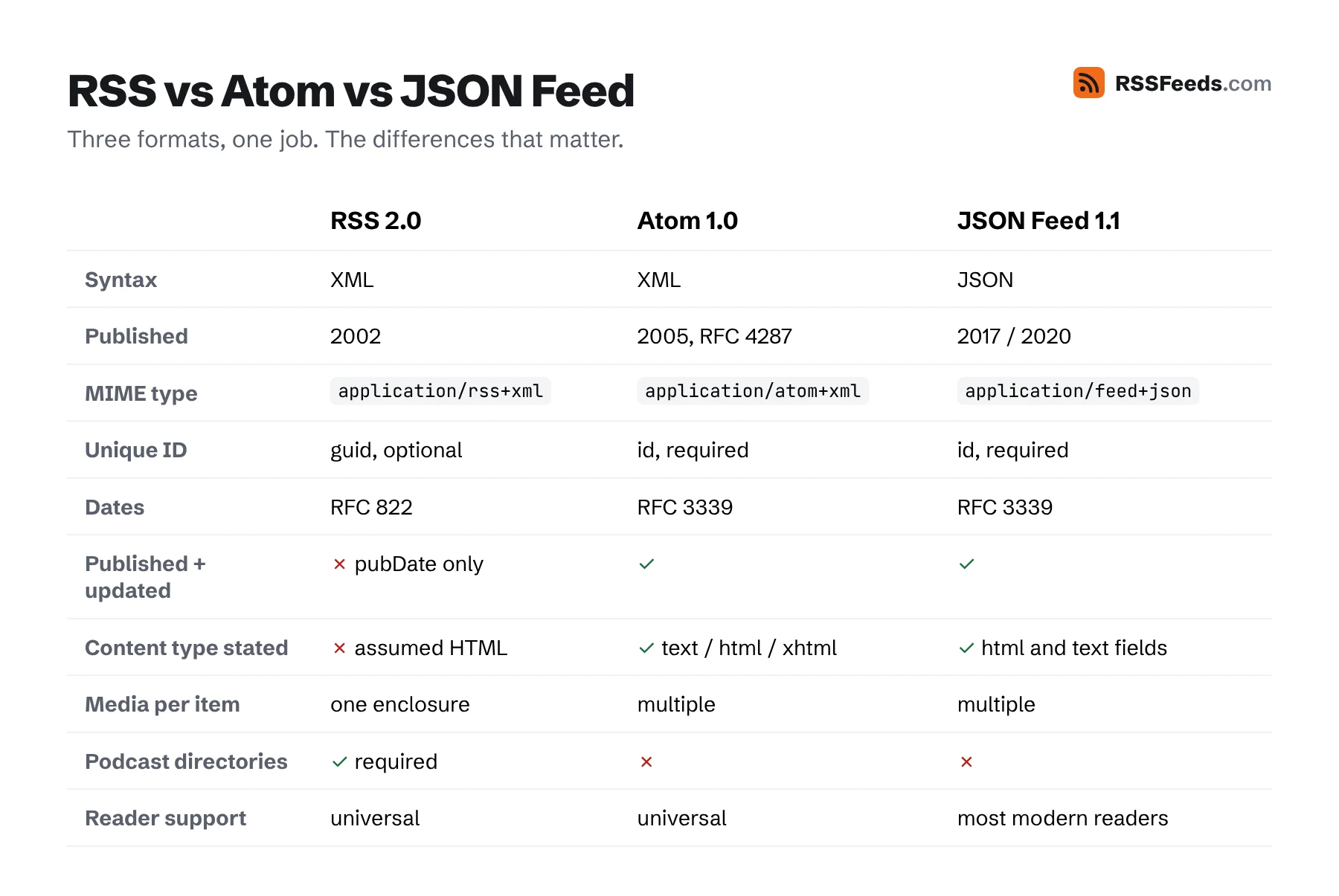
| RSS 2.0 | Atom 1.0 | JSON Feed 1.1 | |
|---|---|---|---|
| Syntax | XML | XML | JSON |
| Standardised by | RSS Advisory Board (frozen spec) | IETF, RFC 4287 | Independent spec by its authors |
| Year | 2002 | 2005 | 2017 / 2020 |
| MIME type | application/rss+xml | application/atom+xml | application/feed+json |
| Required feed fields | title, link, description | id, title, updated (+ author) | version, title, items |
| Required item fields | title or description | id, title, updated | id, content_html or content_text |
| Unique ID | guid (optional) | id (required) | id (required) |
| Dates | RFC 822 | RFC 3339 | RFC 3339 |
| Published vs updated | pubDate only | published and updated | date_published and date_modified |
| Content type stated | No, assumed HTML | Yes: text, html, xhtml | Yes: separate fields |
| Summary and full content | description + content:encoded | summary + content | summary + content_html |
| Authors | Email only; names via dc:creator | Person with name, email, URI | Objects with name, url, avatar |
| Media files | One enclosure per item | Any number of enclosure links | Any number of attachments |
| Podcast directories | Required | Not accepted | Not accepted |
| Extensions | XML namespaces | XML namespaces | Keys starting with _ |
| Language | language element | xml:lang on any element | language field |
| Reader support | Universal | Universal | Most modern readers |
The Same Item in Three Formats
<item>
  <title>Hello world</title>
  <link>https://example.com/hello</link>
  <guid isPermaLink="true">https://example.com/hello</guid>
  <pubDate>Wed, 11 Nov 2026 09:00:00 +0000</pubDate>
  <description><![CDATA[<p>My first post.</p>]]></description>
</item><entry>
<id>https://example.com/hello</id>
<title>Hello world</title>
<link rel="alternate" href="https://example.com/hello" />
<updated>2026-11-11T09:00:00Z</updated>
<content type="html"><p>My first post.</p></content>
</entry>{
"id": "https://example.com/hello",
"url": "https://example.com/hello",
"title": "Hello world",
"date_published": "2026-11-11T09:00:00Z",
"content_html": "<p>My first post.</p>"
}Which Format Do Popular Platforms Use?
| Platform | Format |
|---|---|
| WordPress | RSS 2.0 by default, Atom and RSS 1.0 also available |
| Substack, Medium, Ghost | RSS 2.0 |
| Blogger | Atom by default, RSS with ?alt=rss |
| YouTube, GitHub, Reddit | Atom |
| Shopify blogs | Atom |
| Mastodon, Bluesky | RSS 2.0 |
| Hugo | RSS 2.0 |
| Jekyll (jekyll-feed) | Atom |
| Micro.blog | JSON Feed and RSS |
| Every podcast | RSS 2.0 |
Readers don't care: they accept all of them. The choice usually comes from your software. Check what yours produces with the Feed Validator.
Strengths and Weaknesses
RSS 2.0
For: universal support, the only option for podcasts, a huge ecosystem of extensions, and the format people mean when they say "RSS". Against: ambiguities – is description HTML or text? Is a guid a URL? Author must be an email. Dates use an old email format that developers often get wrong.
Atom
For: precise and unambiguous, mandatory IDs and update times, explicit content types, proper internationalisation, multiple enclosures, and a standard publishing protocol. Against: a bit more verbose, requires an author, and podcast platforms don't accept it.
JSON Feed
For: trivial to generate and parse in any language, no XML escaping or CDATA, separate HTML and text fields, multiple attachments. Against: younger and less universal; some aggregators, automation tools and enterprise systems only accept XML feeds.
Switching Formats
Changing format means changing the feed URL, so redirect the old URL with a 301 to keep subscribers. Make sure IDs stay identical across formats – use the same permalink as guid, Atom id and JSON Feed id – so readers don't show your posts twice. The Feed Converter shows what your feed looks like in each format.
Sources and Further Reading
- RSS 2.0 SpecificationRSS Advisory Board
- RFC 4287: The Atom Syndication FormatIETF
- JSON Feed Version 1.1jsonfeed.org