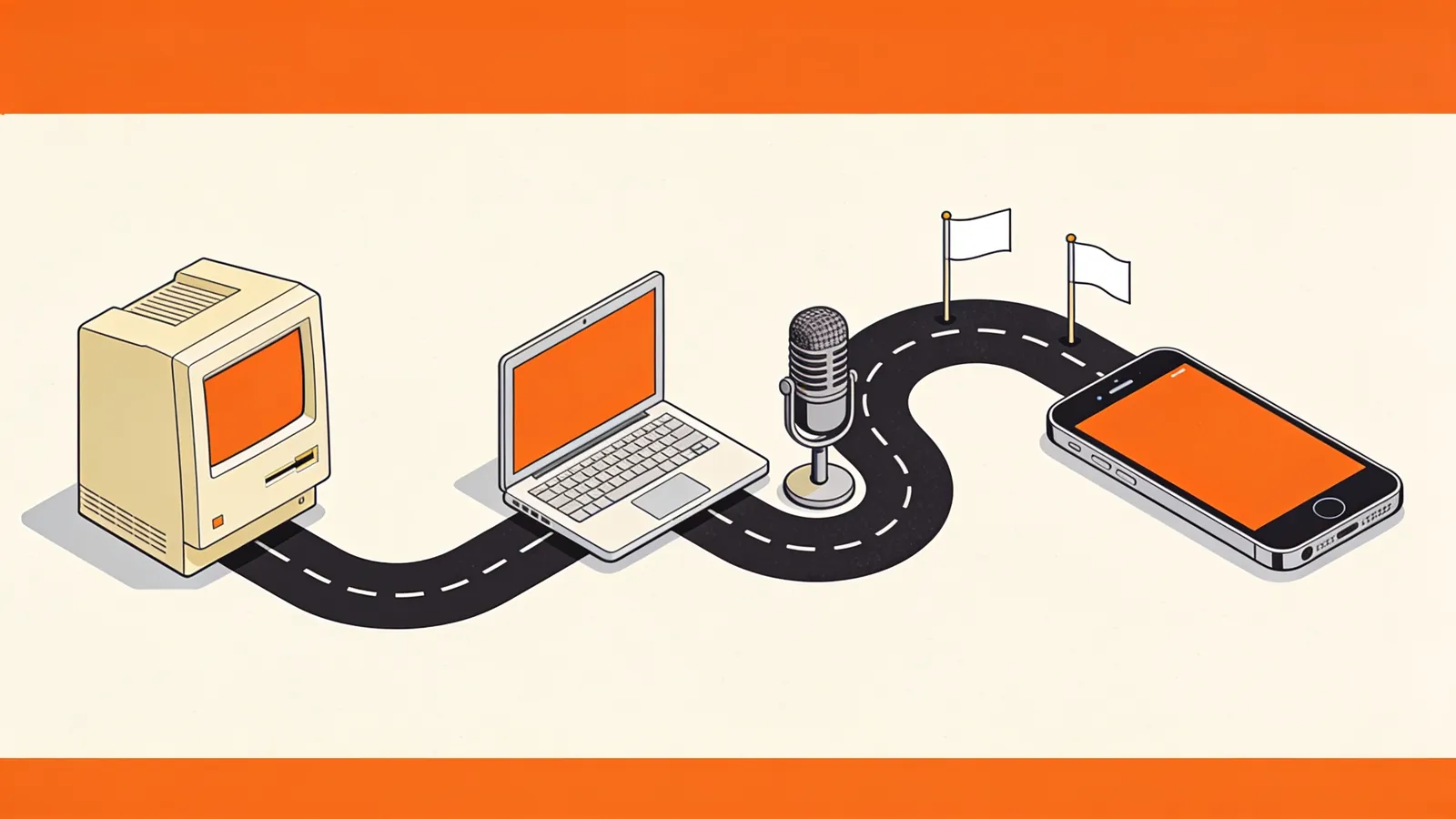
Before RSS
The idea of describing a website's content in a machine-readable way came before RSS. In the mid-1990s Ramanathan V. Guha worked on the Meta Content Framework at Apple. In 1997 Microsoft proposed the Channel Definition Format for "push" channels in Internet Explorer, and Dave Winer of UserLand Software published his weblog, Scripting News, in an XML format of his own. Push technology was the hype of the year, and then mostly disappeared.
Timeline
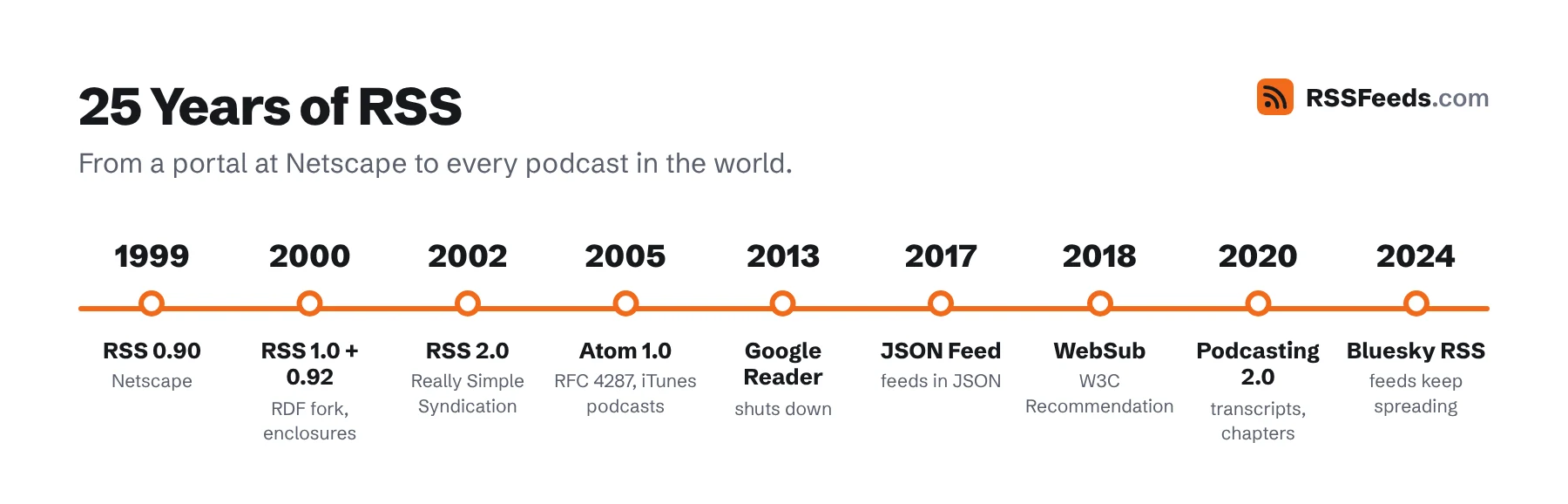
- Netscape releases RSS 0.90, "RDF Site Summary", created by Guha and Dan Libby so websites could appear as channels on the My Netscape portal.
- RSS 0.91 drops RDF for a simpler format, borrowing ideas from Scripting News. The name is read as "Rich Site Summary".
- Netscape loses interest. UserLand publishes its own version of 0.91. A group of developers, the RSS-DEV Working Group, publishes RSS 1.0, returning to RDF with extension modules. Weeks later UserLand releases RSS 0.92, adding the
enclosureelement. Two incompatible branches now share one name. - Dave Winer and Adam Curry experiment with audio in enclosures – the technical seed of podcasting.
- UserLand releases RSS 2.0, "Really Simple Syndication", continuing the 0.92 line with namespaces and the
guid. - The RSS 2.0 specification is handed to Harvard's Berkman Center under a Creative Commons license and frozen; an RSS Advisory Board forms to maintain it. Frustrated by the forks and ambiguities, developers start a new format that becomes Atom.
- "Podcasting" gets its name. Blogs are booming, and feed readers such as Bloglines and NetNewsWire help readers keep up with them.
- Apple adds podcasts to iTunes, along with the
itunesnamespace that still defines podcast feeds. - Google Reader launches and becomes the most popular way to read feeds.
- The IETF publishes Atom 1.0 as RFC 4287. The orange feed icon from Firefox is adopted by Internet Explorer and Opera, giving feeds a shared symbol.
- OPML 2.0 is published, and RFC 5023 standardises the Atom Publishing Protocol.
- PubSubHubbub brings real-time push to feeds; rssCloud is revived.
- Google announces the end of Google Reader; it closes on July 1, 2013. Millions of users move to Feedly, Inoreader, NewsBlur, The Old Reader and others. Many people conclude that RSS is dead. It isn't.
- JSON Feed 1.0 is published by Brent Simmons and Manton Reece.
- PubSubHubbub becomes WebSub, a W3C Recommendation. Later that year Firefox removes its built-in feed features.
- JSON Feed 1.1 is released. The Podcast Index community launches the Podcasting 2.0 namespace with transcripts, chapters and more.
- Podping introduces a shared, real-time notification network for podcast feed updates.
- Bluesky adds RSS feeds for every profile, arXiv rebuilds its RSS service, and Google Podcasts closes.
- Browsers announce the removal of XSLT, which publishers used to style feeds in the browser. Meanwhile, interest in RSS grows again as people look for alternatives to algorithmic timelines.
Why the Version Numbers Are Confusing
The two branches – RDF-based (0.90, 1.0) and simple XML (0.91, 0.92, 2.0) – were developed by different groups who disagreed about what RSS should be. RSS 1.0 isn't an ancestor of RSS 2.0, and "RSS" was expanded three different ways. Atom was created partly to escape that history with a clean, vendor-neutral standard. In practice, readers have supported every version for two decades, which is why the "format wars" ended up mattering less than the arguments suggested. Details of the early versions are in RSS 1.0 and RSS 0.9x.
Why RSS Survived
- It's simple. A feed is a text file that any system can produce.
- It's open. No company owns it, so no company could shut it down – not even when Google closed Reader.
- Podcasting depends on it. A multi-billion-dollar industry is built on RSS enclosures.
- It works in the background. Apps, aggregators, automation tools, search engines and AI crawlers read feeds every second, even if people don't see them.
- Algorithm fatigue. Chronological, user-controlled reading is attractive again.
New to all this? Start with What is RSS?.
Sources and Further Reading
- RSS HistoryBerkman Klein Center
- RDF Site Summary (RSS) 1.0RSS-DEV Working Group
- A Second Spring of CleaningGoogle
- RSSWikipedia